· Education · 6 min read
Good Enough for My Gym Bros
Explaining a statistical idea is not the same as explaining AI. But the bigger problem starts when “good enough for my audience” becomes an excuse for giving people a misleading picture of what they know.
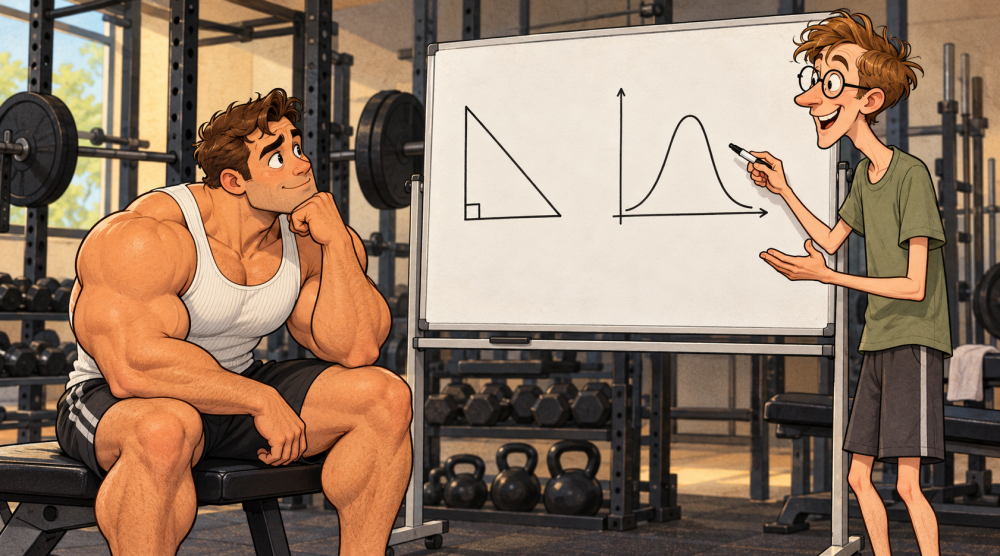
A photograph has been doing the rounds on social media lately: a set of gym weights with markings worn away to different degrees. Cue the jokes about the normal distribution. Fair enough. It is a neat visual association, and I am leaving the photograph out because I do not know who owns it or what permission would be needed to reproduce it. You will have to imagine some gym equipment. Consider it your first exercise.
Then someone shared it with a remark about never expecting to explain AI to their gym bros. That was where my blood pressure joined the workout. Basic statistics matters to AI, certainly. But discussing a distribution is not, by itself, explaining AI. The connection exists; the description is doing considerably more lifting than the photograph. By the same logic, explaining the difference between a knife and a fork qualifies as surgical training. A scalpel is a knife, after all.
Still, an inflated description of a casual conversation would hardly justify an entire article. People make jokes. People get enthusiastic about connections between subjects. What stayed with me was the response to objections, including the observation that the photograph did not even establish a normal distribution: “It’s enough for my gym bros.” That shifted the conversation. Whether the explanation was accurate had apparently become less important than who was receiving it.
Who gets blamed when learning fails?
We are remarkably quick to diagnose the limitations of an audience. The subject is too difficult. People have no attention span. Nobody wants to think anymore. Occasionally, those observations may contain some truth. But they also offer a wonderfully convenient account of a failed explanation: the person speaking supplied the knowledge, and the people listening failed to absorb it. An unfortunate outcome, obviously, but the speaker’s contribution has been cleared of all charges.
Teaching involves at least two contributions. Someone has to make an effort to learn, and someone has to prepare something worth learning from. That second contribution exists even when there is no teacher in the room. A textbook has an author. A video course has a creator. Someone chooses the examples, checks the claims and decides what needs explaining before the next step will make sense. Long before a learner loses concentration, a series of decisions has already shaped what they are being asked to understand.
If that material is wrong, effort alone will not rescue the learner. They can listen carefully, take excellent notes and faithfully reproduce the explanation, only to become more confidently mistaken. A beginner is particularly poorly placed to catch the problem: the knowledge needed to evaluate the explanation may be precisely the knowledge they came to acquire. Good intentions on the teacher’s part do not resolve this. Sincerely delivered nonsense remains nonsense, although it may come with a reassuring smile.
Making the explanation do its job
None of this means every introduction needs an avalanche of qualifications. Nobody should have to survive an entire undergraduate syllabus before being allowed to ask an interesting question. A teacher’s job includes choosing a manageable scope, finding useful examples and explaining unfamiliar ideas in language the audience can follow. Making that experience enjoyable is an achievement too. Humour, familiarity and a good analogy can give someone a reason to stay with an idea long enough to understand it.
But selecting what to leave out requires judgment. There is a difference between explaining one small thing clearly and claiming to have explained a much larger thing because the smaller thing happens to appear somewhere inside it. “Here is a statistical idea that also matters in AI” would have been a perfectly reasonable introduction. It offers a connection without handing out an imaginary qualification. The gym bros could learn something, ask questions and get on with their workout. Nobody needs to perform emergency surgery with the cutlery.
But a beginner who receives that explanation with an authoritative “and now you understand AI” has been given a misleading impression of their own knowledge. It is rather like being told that learning the difference between revenue and profit makes you a doctor of economics. Without knowing the field, how are you supposed to judge how much of it you have actually understood? That lack of perspective leaves a learner vulnerable to overestimating their understanding. When the teacher supplies the inflated assessment and lends it their authority, they reinforce the very misconception they should help the learner recognise. Houston, we have a problem.
The temptation to trivialise complicated subjects sometimes arrives under the grand banner of fighting gatekeeping. Making knowledge accessible is a worthwhile ambition. It also makes a convenient defence when someone questions the quality of an explanation. There is a larger discussion to be had about access, expertise and simplification, but it deserves its own article. For now, the relevant question is simple enough: does invoking accessibility actually answer the correction, or merely make the person raising it sound unreasonable?
Of course, learners still have responsibilities. They need to pay attention, practise, ask questions and tolerate some confusion. A failure to understand does not automatically prove a failure to teach. There are limits to what any explanation can accomplish, especially in a casual conversation between sets. Respecting an audience includes accepting that learning requires something from them. It does not require pretending that every subject can be absorbed effortlessly while waiting for a bench to become available.
That is why “enough for my gym bros” bothers me. Enough for what? To start an interesting conversation? Quite possibly. To leave them believing they have learned something they have not? That is a different standard. Their current lack of knowledge tells us very little about their capacity to understand, and nothing about whether they deserve an accurate explanation. They may be beginners in this subject. That gives the person teaching them a responsibility, not a licence to lower the quality of what they receive.
If I explain something badly, I would rather improve the explanation than defend it by lowering my opinion of the people listening. They have already done something worth respecting: they were willing to learn. The least I can do is take that willingness seriously.
This is exactly the principle I try to follow in my Fuckup Almanac series: make complicated subjects accessible and engaging while taking both the subject and the reader seriously.