

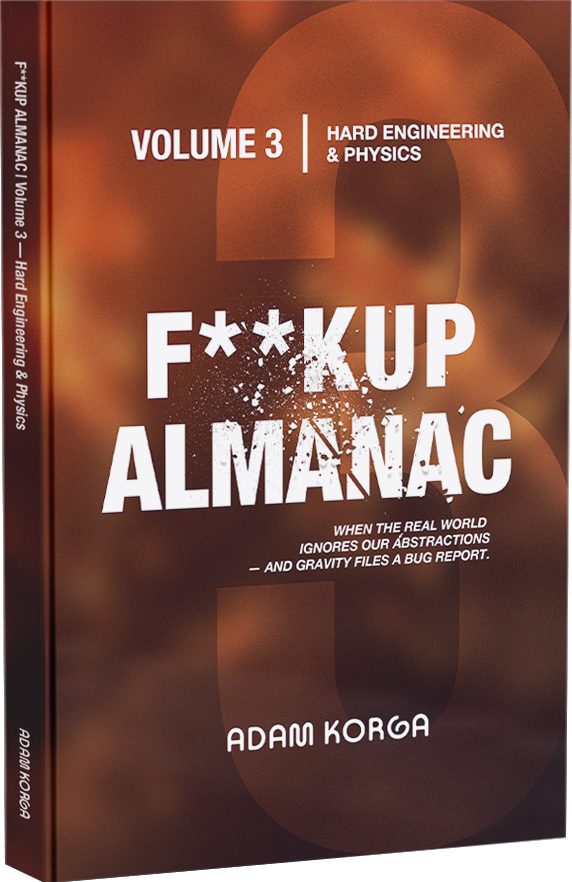
Vol 3: Hard Engineering & Physics
Two teams can build a bridge to the dimensions on their drawings and still end up with a step where the two halves meet. A skyscraper can do a perfectly respectable job of standing up while its windows concentrate enough sunlight to damage a parked car. In both cases, somebody had a much narrower definition of “works” than the people who had to live with it.
The first two volumes of Fuckup Almanac followed failures through the foundations of computing and the layers of software we built on top. Volume 3, Hard Engineering & Physics, takes the investigation out of IT and into bridges, buildings, factories, and aircraft. The subject this time is the mistake itself. Why do fiendishly smart people, working on wildly different problems, keep finding suspiciously similar ways to get things wrong?
Sometimes a decision makes perfect sense to everyone in the room because the person who knows what it will break is in another room. Sometimes a safety margin gets spent a little at a time, each change small enough to look harmless on its own. By the time the consequences are visible, the original decision may be years old and buried in a drawing everyone assumes somebody else checked.
There are plenty of disasters in this book, some so absurd that a Hollywood producer would send the script back with “too much” scrawled in the margin. Reality has no script editor. They actually happened.
But the interesting part is reconstructing the ordinary decisions that made them possible, including the reasoning that seemed sound at the time. Hindsight makes it easy to spot the fatal assumption. The book spends more time asking why it was so easy to miss. Someone with a slightly bigger stick up their backside might call this a gradual attempt to build an epistemology of error.
You can start here with no engineering background and no homework from the first two volumes. Along the way, we’ll explore the mechanics together, from how a building carries its weight to what happens when a vessel runs out of room for rising pressure. If you work in IT, construction, aviation, or any field where your work has to fit somebody else’s, you may recognize a few arguments from your own meetings. The units will probably be different.
At a Glance
- 79 real-world case studies, from bridges to chemical plants.
- 15 explainers on concepts like scale effects and safety margins.
- Just enough physics and engineering to see what went wrong.
- The reasoning that made bad decisions seem sensible at the time.
- The same mistakes turning up in very different branches of engineering.
- A few detours into IT to see those patterns in familiar territory.
- Dry humor where it fits, a sober tone when lives are lost.
- More than 1,100 source documents for anyone following the paper trail.
- A standalone read for anyone curious about how things break.
Table of Contents
Part XII: Reality Had Tricks Up Its Sleeve
A material behaves itself in the lab, two harmless components get into trouble together, and a model that worked beautifully has the indignity of being built. Then the fix reveals what the original problem was keeping in check.
- Chapter 45: Matter Broke the Rules First
- Chapter 46: Apparently, These Two Know Each Other
- Chapter 47: Works on My Machine... Upscaled
- Chapter 48: The Fix Worked. Unfortunately.
Part XIII: The Answer Was Next Door
Someone down the corridor could have told you why this was a bad idea. Unfortunately, they work in a different department. We look at designs that made perfect sense until they met another discipline or an actual human.
- Chapter 49: The Designer Skipped That Class
- Chapter 50: Expert in Half the Problem
- Chapter 51: The Blueprint Assumed Better Humans
Part XIV: I Thought You Had It
The number arrived safely. Its units had a less successful trip. We follow mistakes through drawings, interfaces, and handoffs to the moment two teams discover they delivered exactly what they each thought they’d agreed to.
- Chapter 52: Lost in Translation
- Chapter 53: Where the Pieces Were Supposed to Meet
- Chapter 54: The Baton Hit the Floor
Part XV: We Heard You, We Just Didn't Listen
Some failures come with advance notice, complete with photographs and a distribution list. We look at how a crack becomes a line item and how years of getting away with something start to feel like proof it’s safe.
- Chapter 55: The Cracks Were on the Report
- Chapter 56: Filed Under Not Now
- Chapter 57: It Always Held Before
Part XVI: Hoping Physics Wouldn't Notice
Turn up the heat, raise the pressure, go a little faster. That’s how engineering moves forward. We look at what happens when you get close enough to a physical limit to decide it’s probably just a rumor.
- Chapter 58: Reactions Don't Stop When Asked
- Chapter 59: Pressure Always Finds the Door
- Chapter 60: Fast and Unforgiving
Ackshually, One More Thing…
Before we close the book, there’s one more thing to say about the choices that look obvious in hindsight.
Supplementary Materials
Chapter 0: The Anatomy of a Post-Mortem
The foundation of the entire Fuckup Almanac series—exploring why studying failures matters and how systematic analysis turns disasters into lessons.
Coming soon in these formats
Finalizing publication. Join the newsletter to get notified when orders open.
Specs are subject to change. Cover art usually finalized 3 months before release.