· Systems · 9 min read
What a 15th-Century Korean Cart Taught Me About Observability (And My Own Broken Brain)
A K-drama subtitle sent me down a rabbit hole into a 15th-century Korean odometer cart—and straight into a lesson about signal aggregation, downsampling, and why your observability stack is only as good as its road coverage.

It is a well-documented medical mystery that some people can simply watch television. They sit down, press play, press pause to grab a beverage, and resume watching without feeling a sudden, burning compulsion to cross-reference 17th-century Korean geography against the legislative timelines of the French Revolution.
I am not one of those people.
Recently, I fell down a K-drama hole and ended up watching Kingdom—a phenomenal show featuring political intrigue, exquisite hats, and historical zombies in Joseon-era Korea. Everything was going smoothly until a scene where Moo-young turns to Prince Yi Chang, who is planning a journey to a distant province, and casually says: “It’s 300km.”
My brain slammed the emergency brake.
Kingdom is set around the year 1601. The metric system was proposed by French scientists in 1791 and officially codified in 1795. Now, look—I know South Korea is currently a global powerhouse in high-tech engineering and high-speed internet, but I was reasonably sure Joseon dynasty ministers weren’t walking around in 1601 measuring royal highways in SI units.
Instead of letting it go like a normal human, I paused the episode, opened twenty tabs, and began my descent down a deeply unnecessary rabbit hole.
What followed wasn’t just a lesson in localization laziness, but a masterclass in a pattern I keep stumbling across: our modern tech industry’s hilarious habit of re-inventing 600-year-old mechanisms and calling them “cutting-edge architecture.” (A flavor of technocentrism I touched on a few months back in Digital Ghosts: The Long, Cynical History of Data Protection).
Rabbit Hole #1: The Overzealous Translator
My initial search immediately yielded the actual culprit: the traditional East Asian distance unit li (리).
Historically, one li was roughly 0.3 to 0.4 kilometers. Do the napkin math: 300 kilometers translates almost perfectly to 1,000 li.
In Korean, 1,000 li (천리) isn’t just a literal measurement; it’s an idiom. You’ve likely heard the proverb “A journey of a thousand li begins with a single step” (천리길도 한 걸음부터). Idiomatically, 1,000 li basically means “a hell of a long way away”—the Korean equivalent of English’s “far, far away” or “beyond the seven seas.” (Or, as we say in my native Polish and other Slavic tongues, za siedmioma górami, za siedmioma lasami, za siedmioma rzekami—“beyond seven mountains, seven forests, and seven rivers”).
Moo-young wasn’t handing the Prince a GPS reading; he was saying, “Bro, that’s a trek.” The Netflix subtitle translator simply had an attack of overzealous precision and converted a poetic figure of speech into a modern metric distance. Mystery solved.
I could have closed my laptop. I could have gone back to watching zombies.
I did not.
(At this point, you’ve likely realized that watching a simple TV show is an excruciatingly time-consuming ordeal for me. You’d be entirely right. I won’t even audit the hours lost pausing to investigate foreign education systems, equipment specs, or—on more than one occasion—spending three episodes drafting completely revised, multi-page tactical plans because the protagonist’s base assault completely ignored a critical operational bottleneck… like flashlight design or shoe durability.)
Rabbit Hole #2: How Did They Measure It?
Because my brain refuses to accept a closed case, a new question immediately presented itself: Wait, if they knew a distance was 1,000 li, how did they actually measure it in 17th-century Korea?
Now, before I proceed, a quick disclaimer: I am not a historian. My total expertise in ancient East Asian mechanical engineering was accumulated over three hours of furious late-night googling while my tea went cold. But bear with me, because the answer is brilliant.
Enter the Girigocha (기리고차 / 記里鼓車)—literally, the “li-recording drum cart.”
While the primitive concept of an odometer cart originated in Han Dynasty China around 100 BCE, Korea perfected its own advanced version. On March 17, 1441, King Sejong the Great set off with his royal court to the hot springs in Onsu-hyeon (modern-day Onyang), accompanied by an official, highly calibrated Girigocha.
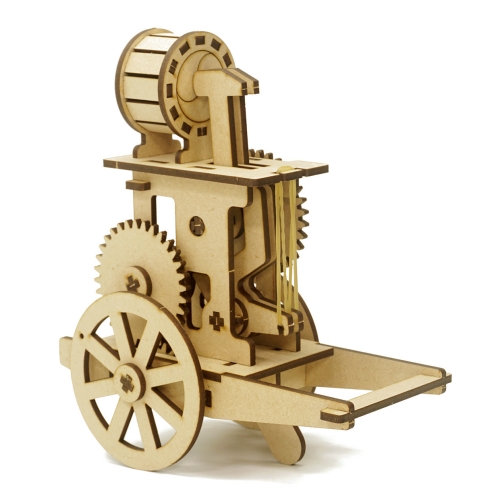
The Girigocha (기리고차 / 記里鼓車), King Sejong’s “li-recording drum cart”
The mechanism was pure mechanical genius:
- The cart’s main wheels were crafted to a precise, standardized circumference.
- As the wheels turned, they drove a sequence of reduction gears inside the wooden chassis.
- The gear ratios were calibrated so that after the wheels covered exactly 1 li, a mechanical arm would trigger a wooden figure to strike a drum.
- If you kept traveling, higher-tier reduction gears kicked in: every 5 li (or 10 li in later iterations), a second figure would strike a brass gong.
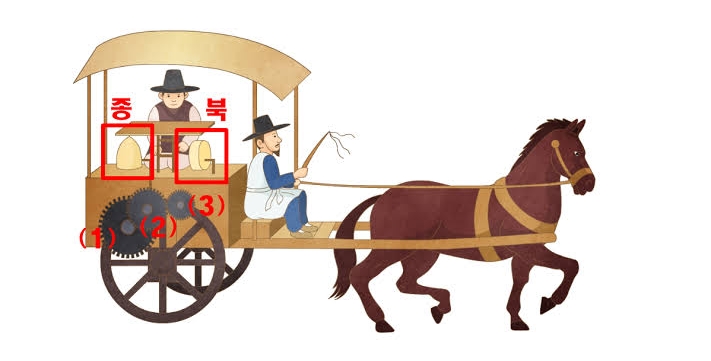
The reduction gears: wheel rotations cascade into drum and gong strikes
A cartographer traveling with the cart didn’t need to count wheel revolutions or guess distances. He just listened for the gongs and drums, logging the signals into an official ledger.
This wasn’t a novelty toy for royalty. The Girigocha was a critical piece of state infrastructure, deployed by the Ministry of Public Works (Gongjo – 공조/工曹) to map the entirety of the Korean peninsula. The distances it logged fed the tradition of geographic record-keeping later gathered in works like the Dongguk Yeoji Seungnam (동국여지승람 / 東國輿地勝覽) — though Korea’s genuinely precise national maps were still centuries off.
Signal Aggregation: Prometheus in 1441
If you step back and stop viewing the Girigocha as a quaint museum artifact, you quickly realize what King Sejong’s engineers actually designed.
On the surface, it’s an odometer. But underneath, it is a system of cascading signal aggregation and downsampling.
Consider the data stream:
- Level 0 (Raw Data): The rotation of the wooden wheel. Thousands of micro-events per mile. High noise, high volume.
- Level 1 (Low Aggregation): The 1-li drum strike. Converts thousands of raw rotations into a single discrete tick.
- Level 2 (High Aggregation): The 5-li or 10-li gong strike. A lower-resolution summary designed for long-range tracking.
If you were a cartographer mapping a 300km journey across Joseon Korea, you didn’t record every turn of the wheel. Doing so would produce an unreadable, useless avalanche of raw noise. You downsampled the data at the point of ingestion. You sacrificed granular micro-precision to gain actionable macro-clarity.
Now, swap out the wooden gears for time-series databases.
This is the exact same architectural pattern we use in modern telemetry, accounting, and observability platforms today. We collect high-frequency raw metric events at the edge, aggregate them into 5-minute rollups, downsample them to hourly buckets for last month’s analysis, and compress them into daily summaries for long-term historical trends.
Downsampling isn’t an annoying compromise forced upon us by hard drive costs—it is a fundamental feature of information design. The royal cartographers of 1441 understood the exact same thing your infrastructure engineers do when tuning Prometheus retention rules: nobody needs to debug last year’s Tuesday at 3:14:02 AM with single-millisecond precision.
Which brings us back to our favorite tech industry myth: that we are constantly inventing brand-new computational paradigms. We aren’t. We’re mostly just taking 580-year-old organizational patterns, implementing them in silicon instead of bronze gears, and adding colorful Grafana dashboards to pitch to venture capitalists.
The Observability Cliff
However, the Girigocha hid a far more profound lesson—one that isn’t about how nicely the system works, but about where it violently breaks down. The cart was an exceptionally accurate instrument, provided one very specific condition was met: it had to remain on a paved, official royal highway. The moment you stepped off the maintained imperial road network and ventured into the rugged, unpaved mountains of Joseon Korea, the cart became useless. The wheels slipped on mud, got jammed on boulders, or simply couldn’t traverse steep inclines.
Off the road, your telemetry didn’t gracefully degrade from 100% precision to 80% precision; it dropped off a sheer, vertical cliff. You went instantly from “exact distance measured to the nearest li” to “uh… it’s about half a day’s hike, maybe a week, screw this I’m turning back.” This is the exact problem crippling modern distributed systems: the telemetry blind spot.
In a modern cloud architecture, you can have immaculate end-to-end observability across 95% of your microservices—distributed tracing is working, OpenTelemetry spans are firing cleanly, and your metrics look like poetry. But the moment a transaction crosses an uninstrumented legacy service, a third-party payment gateway, or a rogue worker running inside a black-box container, you hit that exact same cliff. You don’t get “slightly less clear” metrics; you land right back in the dark ages, left staring at a failed request log with a stack trace that tells you nothing.
Your observability system is never as good as the quality of your instruments—it is only as good as your road coverage.
Nothing New Under the Sun
It turns out King Sejong’s cartographers and modern site reliability engineers suffer from the exact same existential crisis: building stunningly sophisticated maps of their domain, while remaining entirely blind the moment they step off the beaten track.
Centuries ago, engineers solved data aggregation with wooden cogs, bronze gongs, and horse-drawn carriages. Today, we solve it with OpenTelemetry, Kafka streams, and cloud-native databases.
The media change, the presentation gets shinier, and the slides for investors get more flashy. But the core patterns—and the human cognitive limitations that drive them—remain completely unchanged.
So, the next time you’re re-architecting your telemetry stack, take a moment to appreciate the Girigocha. And the next time a throwaway detail in a show or a weird legacy quirk in your codebase triggers a sudden pause—don’t fight the urge. Pull the thread. Underneath almost every piece of shiny “cutting-edge” tech you use daily lies an ancient mechanical or organizational blueprint waiting to be recognized.
We don’t need to reinvent the wheel—we just need to notice the gears that were already turning long before we got here.
Li, ri, and distances that are not always meant literally
Traditional East Asian distance units survived not only as measurements but in proverbs, literary expressions, and cultural shorthand for very long distances.
3 sources
Li, ri, and distances that are not always meant literally
Traditional East Asian distance units survived not only as measurements but in proverbs, literary expressions, and cultural shorthand for very long distances.
- Korean Wiki ProjectAccessed: 2026-08-23
An English-language explanation of the Korean proverb "발 없는 말이 천리 길 간다" — literally, words without feet can travel a thousand ri. It glosses ri as an old distance unit of approximately 0.4 km and explains the expression as referring to how quickly rumours spread. Useful evidence that large numbers of ri appear idiomatically in Korean, rather than functioning only as literal measurements.
- Chinese Text Project LaoziAccessed: 2026-08-23
Chapter 64 contains the classical expression 千里之行,始於足下 — commonly rendered as "a journey of a thousand miles begins with a single step," although the original unit is li. Useful as broader East Asian context for the long-standing literary and proverbial use of large distances expressed in li.
Yes, I used Google Translate for this and I am not ashamed of it.
Overview of the changing historical values and cultural uses of li across China, Korea, and Japan. Particularly useful for the Korean ri: the modern traditional value is approximately 392.72 metres, while "samcheon-ri" ("three thousand ri") became a poetic expression for the Korean peninsula. Best used as supporting context rather than as the principal historical source.
Note that there are two transcriptions of the Korean unit: ri and li. In the article I am using "li" as I am referring to the historical unit. The modern Korean form of the unit is usually transcribed as "ri".
Girigocha: a mechanical odometer in Joseon Korea
The distance-measuring carriage that turned wheel rotations into mechanically generated signals centuries before electronic telemetry.
2 sources
Girigocha: a mechanical odometer in Joseon Korea
The distance-measuring carriage that turned wheel rotations into mechanically generated signals centuries before electronic telemetry.
- Encyclopedia of Korean Culture — Academy of Korean Studies Park Heung-soo 1995Accessed: 2026-08-23
The strongest general source for the Joseon Girigocha. Describes it as a distance-measuring carriage and records its first reported royal use on March 17, 1441, when King Sejong and the queen travelled toward the hot springs at Onsu-hyeon.
The article describes a wooden figure striking a drum after one ri. It also discusses the earlier Chinese design: an 18-cheok-circumference wheel driving gears that counted rotations, with 100 wheel rotations corresponding to one ri; a drum marked each ri and a bell each ten ri.
Importantly, some reconstruction details are explicitly presented as inference. The article suggests that the Sejong-era carriage probably used a similar mechanism and speculates that Jang Yeong-sil may have built it. These details should therefore not be presented as firmly documented facts.
- National Geographic — Out of Eden Walk Paul Salopek 2025Accessed: 2026-08-23
An accessible English-language description of the Girigocha in the context of the historic Yeongnamdaero road. Salopek describes a horse-pulled wagon using wheel rotation to measure distance and mechanically producing drum and bell signals. He connects such measurements to the spacing of road infrastructure along the route.
The drum/bell intervals reported here are reversed relative to the Academy of Korean Studies description of the historical mechanism. For exact mechanical details, the Academy source should therefore take precedence; this article is most useful for English-language context and the relationship between measurement and road infrastructure.
Sejong's journey and the documentary record
The royal journey of 1441 and the later Joseon tradition of systematically compiling knowledge about the state, its institutions, and its technology.
4 sources
Sejong's journey and the documentary record
The royal journey of 1441 and the later Joseon tradition of systematically compiling knowledge about the state, its institutions, and its technology.
- Encyclopedia of Korean Culture — Academy of Korean Studies Park Heung-soo 1995Accessed: 2026-08-23
Citing the Annals of King Sejong among its primary references, the entry records March 17, 1441 as the first reported occasion on which the distance-measuring carriage was used by the king. Sejong and the queen were travelling toward the hot springs at Onsu-hyeon, in present-day Asan.
- UC Berkeley Library Digital Collections — Asami Collection Hong Pong-han, Kim Chʻi-in et al. 1770Accessed: 2026-08-23
Digitised bibliographic record and surviving volumes of the 1770 Tongguk munhŏn pigo (Dongguk Munheon Bigo). The Berkeley catalogue identifies the work as a 100-volume Korean reference work published in the 46th year of King Yeongjo's reign and classifies it among dictionaries and encyclopedias.
- University of Maryland — DRUM Bing Kuen Anthony Law 2016Accessed: 2026-08-23
Academic study centred on the Tongguk Munhŏn pigo, which it translates as "Encyclopedia of Documents and Institutions of the East Kingdom." The dissertation describes the 1770 work as an encyclopedic compilation produced within the Joseon governmental and court context and examines how earlier documentary material was gathered and interpreted within it.
Useful for establishing that Dongguk Munheon Bigo was not merely a modern label attached to a miscellaneous old manuscript, but a substantial eighteenth-century encyclopedic reference work concerned with Joseon institutions and accumulated documentary knowledge.
Leaving this for context... and to illustrate how weirdly my research could go.
- University of Michigan — Nam Center for Korean Studies Anthony Law 2014Accessed: 2026-08-23
Describes Tongguk Munhŏn pigo (1770) as the first official encyclopedia in Korean history and notes that it consisted of thirteen topical sections. Useful compact English-language institutional context for the work and its status as an official Joseon reference compilation.
From wheel rotations to telemetry: aggregating signals
Modern observability systems formalise the same general move from numerous low-level measurements to fewer higher-level signals that humans can actually use.
1 sources
From wheel rotations to telemetry: aggregating signals
Modern observability systems formalise the same general move from numerous low-level measurements to fewer higher-level signals that humans can actually use.
- Prometheus Documentation Prometheus Authors 2026Accessed: 2026-08-23
Official Prometheus guidance on recording rules and aggregation. Prometheus explicitly models multiple aggregation levels and recommends names of the form "level:metric:operations", where the level identifies the aggregation level represented by the resulting time series.
The examples show measurements being progressively aggregated by removing lower-level dimensions such as individual instances and paths, eventually producing job-level signals. This provides a modern software analogue for the article's central comparison: many low-level physical events can be mechanically or computationally transformed into progressively coarser, more useful observations.
The analogy to Girigocha should remain an analogy rather than a claim of technical equivalence: Prometheus aggregates time-series data mathematically, while Girigocha physically counted wheel rotations and emitted discrete signals after distance thresholds were reached.