· Systems · 10 min read
Zawinski’s Law Was Too Modest
Every program expands until it can read mail — and so does every company. A field guide to bloat, strategic diversification, and the vanishing brake that used to say "enough."

The Physicist Crushed by His Own Gravity
In 1995, Jamie Zawinski formulated the most enduringly cynical axiom in software engineering: “Every program attempts to expand until it can read mail. Those programs which cannot are replaced by those which can.”
It was a brilliantly sour observation about feature creep, but history preserved the real punchline for the footnotes: Zawinski was a lead engineer at Netscape, and he personally wrote Netscape Mail.
The man who named the gravitational pull of software was also the first body pulled into the black hole.
This sets the ground rules early: bloat is not a character flaw brought in by clueless middle managers or malicious product owners. It is a fundamental law of physics. Nobody escapes it — not even the guy who drafted the theorem.
Two PR Departments, One Disease
Zawinski was being far too modest. He pretended he was writing a cautionary tale about C code and memory leaks, but he was actually describing what happens to literally anything that achieves runaway success.
Everything that wins eventually outgrows its original container, looks at its neighbor’s fence, and decides to annex the yard.
The only real difference is vocabulary:
- In software engineering, when a single tool tries to do twelve unrelated things badly, we hang our heads in shame and call it bloat.
- In corporate boardrooms, when a single company tries to do twelve unrelated things badly, we put on a Patagonia vest and call it strategic diversification.
It is the exact same metabolic disorder; it just depends on which PR department handles the slide deck.
To understand where this goes wrong, we have to return to an old friend from my earlier argument for engineering friction: a 16th-century Swiss physician I apparently can’t stop dragging into software engineering. Paracelsus had a useful rule: the dose makes the poison.
Expansion itself is not an illness. In fact, a healthy organism must expand to survive. But, just like friction, optimization, or almost anything else in a complex system, growth has a dosage. The fatal boundary isn’t whether you grow, but whether that growth remains adjacent to the core — or metastasizes into an unrecognizable tumor.
Software Bloat: Exhibit A and Exhibit B
Let us first examine the crime scene where Zawinski left it: modern software.
Exhibit A: Jira and the Consumption of Opsgenie
In 2018, Atlassian bought Opsgenie — a crisp, focused, highly reliable on-call alerting tool. It did one job and did it well: when production burned down at 3:00 AM, it woke you up.
Then the Atlassian digestive tract did what it always does.
On June 4, 2025, Atlassian pulled the plug on standalone sales, setting a hard execution date for April 5, 2027. Opsgenie ceased to be a product; it was pulverized and reassembled as a nested sub-tab deep within Jira Service Management. You can no longer just have an on-call alert; you must operate an industrial-grade enterprise ticketing ecosystem that requires three full-time certified Jira administrators just to grant you permission to wake up your colleague.
And because no software in 2026 can exist without joining the AI cargo cult, they immediately bolted on an “Incident Command Center” powered by Rovo AI. Jira has officially reached the thermodynamic endpoint of computing: it can simultaneously read your mail, route your tickets, and hallucinate your root-cause analysis.
Exhibit B: The Zombie Grotesque (Winamp)
If Jira represents living bloat, Winamp is the post-mortem horror show.
In 1997, Winamp was a 2-megabyte miracle that really whipped the llama’s ass. It decoded MP3s instantly on a Pentium 166. Then came Winamp3, then Winamp 5, then CD rippers, video playback engines, and bloated media library databases. It abandoned the very thing that made it sacred — weightlessness — and handed the crown to streamlined alternatives.
Yet Zawinski’s gravity operates even after brain death. The reanimated zombie corpse of modern Winamp eventually managed to integrate an embedded browser based on IE10 and, in a fit of peak late-stage desperation, NFT music playback support.
A piece of software does not stop expanding just because it died. It keeps bloating in the morgue, long after the living have stopped caring.
The Bridge: Tractors and Supercars
Before we condemn expansion entirely, let’s be fair: not every branch is a parasite. Sometimes the branch becomes the tree.
Ferruccio Lamborghini made tractors. He made very good tractors. When he decided to build a high-performance grand tourer, it wasn’t corporate bloat — it was the birth of an iconic automotive brand. And crucially, Lamborghini Trattori still exists today, churning European topsoil as a completely separate, viable entity.
Note the direction of travel, though, because it’s the opposite of everything else in this article. Every other case here is a core reaching out to bolt on a periphery. Lamborghini is a periphery that outgrew its trunk and left home to found its own house. That isn’t adjacency — it’s fission. Expansion isn’t a guaranteed death sentence; when an offshoot discovers a massive, self-sustaining identity, it can split off and thrive on its own terms.
The problem begins when the mothership refuses to let the children have their own houses — or worse, when the mothership starts adopting pets it has no idea how to feed.
The Healthy Dose: Adjacency That Closes the Loop
A healthy expansion is defined by tight adjacency. It doesn’t distract the user; it completes an existing circuit.
- Microsoft Teams → Office 365: Tech purists love to hate Teams, but inside the corporate firewall, it works. It captures the user where they already live — in spreadsheets and slide decks — and closes the enterprise communication loop. It is adjacent to the daily workflow.
- Hyundai Capital → Hyundai Motors: A captive auto-financing arm doesn’t dilute the automotive brand. It exists solely to lubricate the purchase of the metal rolling off the assembly line. You build the car; you finance the car. The loop is closed.
This is the left side of the Paracelsus curve: minimal, adjacent, reinforced. It strengthens the core.
The disaster begins when a company looks at its pile of cash, convinces itself that “brand synergy” is magic dust, and crosses the event horizon.
The Toxic Overdose: Sony’s Identity Crisis
Nobody illustrates the pathology of unhinged expansion better than Sony.
Through the 1990s and 2000s, Sony suffered from what The New York Times accurately diagnosed as a “bloated and bewildering lineup.” They became a hungry machine eating anything in sight: high-end electronics, low-end gadgets, music labels, Hollywood movie studios, online banking, and life insurance.
The outcome? The undisputed king of consumer electronics — the company that taught humanity how to carry music in their pockets with the Walkman — was systematically gutted. Apple ate their music business with the iPod, and Samsung ate their displays. Sony was reduced to building televisions using display panels bought from their fiercest rivals (Samsung and LG), while retaining only one surviving crown jewel in hardware: PlayStation.
The Controlled Experiment: Hollywood vs. PlayStation
Sony offers an almost suspiciously convenient comparison: they effectively ran two versions of the same strategic experiment under one roof, with radically different results.
- Hardware seeks content (Movies): Sony bought Columbia Pictures in 1989 on the premise that owning movies would help sell Trinitron TVs and video players. It was a cultural and operational nightmare. Filmmaking was an alien industry that diluted management focus and produced zero meaningful synergy with consumer electronics.
- Hardware seeks content (Gaming): Sony acquired game development studios to feed software to PlayStation. It created an empire and won the console wars.
Why did one fail and the other conquer the market? Adjacency.
Interactive software development is natively glued to gaming console architecture; it shares engineering DNA, identical user incentives, and direct feedback loops. Hollywood film production, on the other hand, was merely an expensive fantasy dressed up in a synergy slide deck.
The Clinical Diagnosis
And here is the ultimate punchline of Sony’s golden bloat era: for years, the single most profitable organ inside this legendary consumer hardware icon was Sony Financial Services — selling life insurance and retail banking in Japan.
When the most lucrative division of a historic audio-video pioneer is a life insurance provider, that is not a triumph
of strategic diversification.
That is a diagnosis.
Auto financing adheres to car sales. Life insurance does not adhere to portable cassette players. It was simply excess capital wandering around looking for returns because the mothership forgot how to build products people loved.
The Chaebol Exception (A Five-Second Breather)
At this point, someone always raises their hand from the back of the room and whispers: “What about South Korea?”
Fair point. The Korean chaebol model is basically Zawinski’s Law elevated to constitutional doctrine. Samsung C&T will build you a nuclear power plant, and Samsung Electronics will sell you a smartphone. (As a loyal Samsung user, I frankly appreciate them generating gigawatts of nuclear energy, given how often I need to recharge my phone battery.)
Let’s be honest, though: the chaebol is a completely different species of corporate genetics — a web of legally distinct sibling entities operating under an umbrella dynasty, not a single software product trying to be its own operating system. It’s a fascinating rabbit hole, and one I’m going to decline to fall down here.
Yet even the kings of omnipotence know when to pull back. In 2015, Samsung calmly packed up its defense division — including the world-class K9 Thunder self-propelled howitzer — and sold it off to Hanwha. Even an organism designed from birth to do everything eventually realizes that building artillery and building OLED panels belong in different rooms.
The Correction: Amputation as a git revert
On October 1, 2025, Sony executed the ultimate corporate cleanup: they spun off Sony Financial Group into a separate, independently traded entity on the Tokyo Stock Exchange.
This was not a celebration of a grand synergy. It was an institutional git revert.
It was the culmination of years of clawing back focus (the “One Sony” doctrine) — an explicit acknowledgment that if you want to remain a premier creative entertainment and sensor technology company, you have to amputate the banking arm.
This is the beat that most analyses of bloat miss: the process is reversible, provided the host organism hasn’t completely rotted out from the center.
The poison can be stopped. The dose can be adjusted. But you must possess the executive discipline to cut off your most profitable anomaly to save your authentic soul.
The Disappearing Brake
Which brings us back to Zawinski and the modern trap.
The boundary between a brilliant feature and unforgivable bloat — between visionary diversification and corporate distraction — has never been about the type of movement. It is always a function of Dose × Adjacency. The exact same impulse that builds an empire will decapitate it if allowed to drift.
When Zawinski wrote his law thirty years ago, there was a silent guardian protecting us from total ruin: Cost.
Writing code was expensive. Compilers were slow. Memory was measured in megabytes, not gigabytes. Physical distribution required pressing floppy disks and putting them in cardboard boxes. That friction acted as an automatic, merciless filter. It killed 95% of stupid ideas before they reached production.
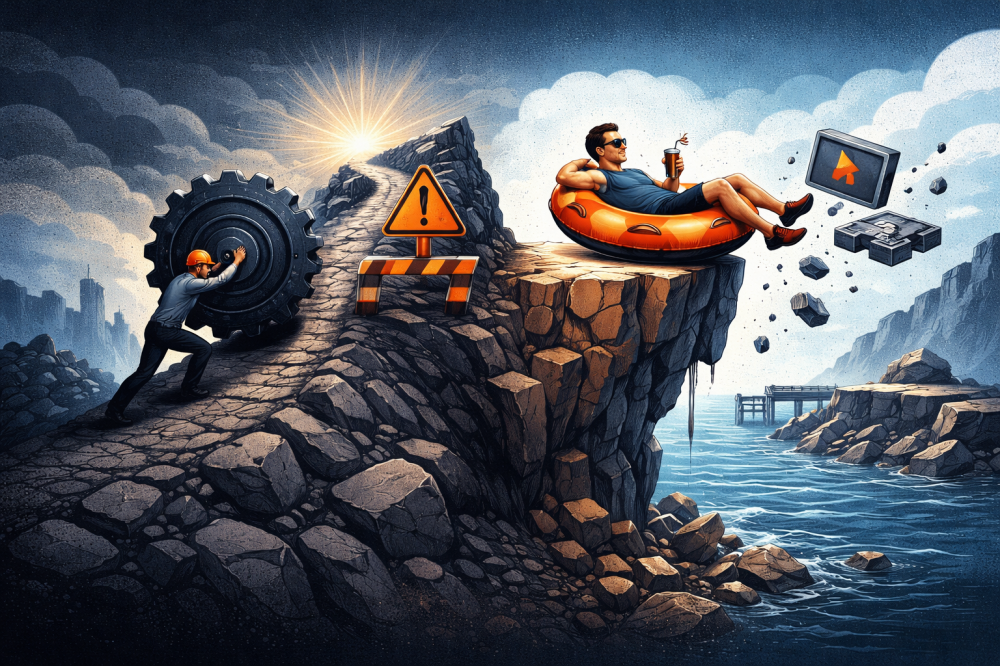
Today, that brake has been completely dismantled.
Adding a software feature is a prompt to an AI coding agent. Entering a brand-new corporate vertical is an acquisition funded by automated debt instruments. Friction-as-a-feature is dead.
When “Can we build it?” drops to zero cost, the filter of capability evaporates. That leaves the entire burden of survival on a single, fragile question: “Should we?”
And that is a mental muscle corporate leadership hasn’t had to train for three decades, because the invoice used to do the thinking for them.
Zawinski warned us that every program would expand until it could read mail. What he didn’t foresee was the day when adding the mail client would be free — and the last thing capable of saying “enough” quietly ceased to exist.
Living bloat: the Atlassian digestive tract
How a crisp, standalone on-call tool was bought, digested, and reassembled as a sub-tab of a ticketing platform — then bolted onto an AI incident hub for good measure.
3 sources
Living bloat: the Atlassian digestive tract
How a crisp, standalone on-call tool was bought, digested, and reassembled as a sub-tab of a ticketing platform — then bolted onto an AI incident hub for good measure.
- Computerworld 2018Accessed: 2026-08-30
The 2018 origin of the acquisition: Atlassian bought Opsgenie for roughly $295 million while simultaneously launching its own Jira Ops. Even at the moment of purchase, the expansion ran on two tracks at once — acquire the incident tool, and grow the ticketing product into the same territory.
- Adaptavist 2025Accessed: 2026-08-30
The execution dates the article relies on: end of sale on June 4, 2025, and end of support on April 5, 2027, after which un-migrated data is deleted. Opsgenie’s capabilities are folded into Jira Service Management. The standalone product ceases to exist as an independent entity.
- ServiceRocket 2026Accessed: 2026-08-30
Source for the AI coda: a June 2026 update notes that at Atlassian Team ’26, Atlassian announced an "Incident Command Center," an AI-native response hub inside Jira Service Management using Rovo AI to investigate root causes and recommend resolution steps. The mail-reading endpoint of computing, reached.
Worth noting for the fair-minded reader: several teams find the migration economics unfavourable and leave for dedicated tools (PagerDuty, incident.io, Rootly). The kombajn absorbs a good standalone tool, degrades it for some users, and pushes a slice of them back toward… separate, specialised tools. The cycle closes.
Post-mortem bloat: it keeps expanding in the morgue
Winamp shed the weightlessness that made it sacred, died as a mainstream product, and then — as a reanimated corpse — grew a browser and NFT playback anyway.
2 sources
Post-mortem bloat: it keeps expanding in the morgue
Winamp shed the weightlessness that made it sacred, died as a mainstream product, and then — as a reanimated corpse — grew a browser and NFT playback anyway.
General history: the 1997 lightweight MP3 player, the poorly received Winamp3 rewrite (2002), the return to Winamp 5 (2003) as a full media suite with library, video, and CD ripping. The trajectory from "weightless" to "media kombajn" that the article treats as the actual cause of death.
- AlternativeTo Ian Dorfman 2022Accessed: 2026-08-30
Source for the zombie-grotesque beat: 2022-era Winamp added NFT music playback, and the piece notes in passing that Winamp’s in-app web browser is based on Internet Explorer 10. A dead product still expanding — into a browser, and into NFTs, on a deprecated engine nobody asked for.
Chronology matters, so the article is careful not to claim the browser killed Winamp. The browser and NFTs are late-stage twitching, years after the bloat that actually ended it. The point is grimmer than causation: the thing kept bloating after it was already dead.
The branch that became a tree
Not every offshoot is a parasite. Sometimes it bifurcates into a self-sustaining identity and the original trunk keeps growing beside it.
1 sources
The branch that became a tree
Not every offshoot is a parasite. Sometimes it bifurcates into a self-sustaining identity and the original trunk keeps growing beside it.
- Lamborghini Trattori (official)Accessed: 2026-08-30
Evidence that Lamborghini Trattori still exists as a going concern, decades after Ferruccio Lamborghini’s move from tractors into supercars. The offshoot (Automobili Lamborghini) grew into an iconic brand while the original trunk kept turning European topsoil — an expansion that bifurcated rather than metastasised.
The famous clutch-and-Enzo origin anecdote is left out of the article on purpose. It has hardened into myth with several competing versions, and the tractors-first fact stands perfectly well without it.
Adjacency that closes the loop
Healthy expansion completes an existing circuit rather than opening a new front — the left side of the Paracelsus curve.
1 sources
Adjacency that closes the loop
Healthy expansion completes an existing circuit rather than opening a new front — the left side of the Paracelsus curve.
- Atlassian Developer Community 2018Accessed: 2026-08-30
Included as the vendor’s own framing of an expansion as loop-closing "synergy" — the exact language the article argues every bloat wears. Adjacency is a real thing, but "synergy" is also the disguise that non-adjacent expansion always puts on. Read both ways.
The toxic overdose
Sony as the clean case: the same "hardware seeks content" move run twice under one roof with opposite results, and a most-profitable organ that read as a diagnosis rather than a triumph.
4 sources
The toxic overdose
Sony as the clean case: the same "hardware seeks content" move run twice under one roof with opposite results, and a most-profitable organ that read as a diagnosis rather than a triumph.
- Revenue Memo 2026Accessed: 2026-08-30
Source for the correction beat: on October 1, 2025 Sony spun off Sony Financial Group and listed it separately in Tokyo, moving financial services out of the segment results entirely. Frames the amputation as a deliberate "return to the core" rather than a failure — the git revert the article describes.
Also the source for the scale of the disentangling: distributing the unit produced a large accounting loss inside discontinued operations even as the retained businesses earned a record operating profit. Handle as "the cost of unwelding something long fused," not as "Sony lost billions."
- Nippon.comAccessed: 2026-08-30
Establishes what actually diluted Sony’s focus: a loss-generating electronics division and a strategic drift into media/entertainment under Idei and Stringer. Important guardrail — the article does NOT claim the financial arm killed electronics; entertainment was the bigger distraction. Finance is a symptom of the same expansion, the one that happened to win.
- IEEE Spectrum 2012Accessed: 2026-08-30
Supports the "bloated and bewildering lineup of gadgets" characterisation and the loss of focus that let Apple and Samsung overtake Sony. Useful for the Walkman-to-iPod and displays-from-rivals narrative, and for the "One Sony" refocusing doctrine referenced in the correction section.
- Robins School of Business, University of RichmondAccessed: 2026-08-30
Background on the 1989 Columbia Pictures acquisition and the premise that owning content would help sell hardware, plus the repeated attempts to sell off peripheral businesses and refocus on the electronics core. Supporting material for the Hollywood-vs-PlayStation controlled experiment.
The chaebol asterisk
A different species of corporate genetics — legally distinct siblings under a dynasty — and even it knows when to sell the artillery division.
2 sources
The chaebol asterisk
A different species of corporate genetics — legally distinct siblings under a dynasty — and even it knows when to sell the artillery division.
- World Nuclear Association 2026Accessed: 2026-08-30
Confirms Samsung C&T’s participation (via consortium with Doosan and Hanwha) in Korean nuclear reactor construction. Grounds the "Samsung will build you a nuclear plant and sell you a smartphone" joke in the fact that these are separate chaebol entities — the point of the whole asterisk.
- Shephard Media 2015Accessed: 2026-08-30
The 2015 sale of Samsung Techwin (K9 Thunder and the rest of the defence pion) to Hanwha, for roughly $759 million. Even an organism built to do everything eventually decides that howitzers and OLED panels belong in different rooms.
Guardrail for the careful reader: this was part of a broader inter-chaebol asset swap, not the same "return to the core" move as Sony’s spin-off. The article treats it as "even the chaebol prunes," not as a twin of the Sony amputation.
The disappearing brake
When cost was high, friction filtered out the stupid ideas for free. That brake is being dismantled on both the software and the capital side.
1 sources
The disappearing brake
When cost was high, friction filtered out the stupid ideas for free. That brake is being dismantled on both the software and the capital side.
- Matt Rickard Matt Rickard 2021Accessed: 2026-08-30
Reused here to anchor the closing argument: the pressure to expand is structural, not a failure of will. When the cost of expressing that pressure (writing the code, shipping the disk, funding the vertical) falls toward zero, the only remaining filter is judgement — and judgement is the muscle nobody trained, because the invoice used to do the thinking.